
By: Lourdes Hernandez and Kelly Morgan, Sentara Health
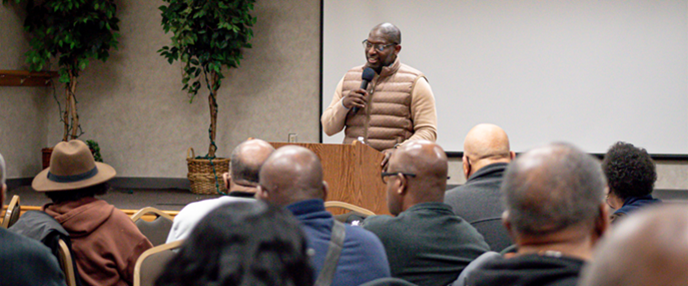
Pastor Williard Maxwell speaks with his congregation at New Beech Grove Baptist Church in Newport News, Va.
In the time it takes to finish reading this story, one man will have died from prostate cancer. Yet with the disease 99% curable if caught early, the question becomes: why are so many still dying?
The topic of prostate cancer is particularly impactful in Virginia. At one point, according to the Eastern Virginia Medical School and ZERO Prostate Cancer, the areas of Petersburg and Hampton Roads ranked among the highest in the nation for prostate cancer deaths among African American men.
While death rates have declined, health disparities, stigma, and fear have created barriers and decades of distrust. For many men, this has made faith and religious communities the first place to go when seeking advice or ways to cope.
A Wake-Up Call in Retirement
Reverend Billy Hunter is a retired naval officer, having dedicated 26 years to military service, during which his health was carefully monitored. But retirement meant that the structured system disappeared–and for the first time, his health was in his own hands.
That reality didn’t fully sink in until he attended the 2025 Ministers Conference at Hampton University. A candid conversation there about prostate cancer opened his eyes to the importance of a complete screening–and motivated him to schedule his first digital rectal exam (DRE).
“I was a little reluctant to come in because I was the youngest in that room,” Hunter recalled. “And I believe the dialogue was very powerful, because I was able to hear some testimonies and experiences of others that were in the room.”
What was once considered a taboo topic became empowering for Hunter, giving him critical knowledge about his own health and the confidence to guide others.
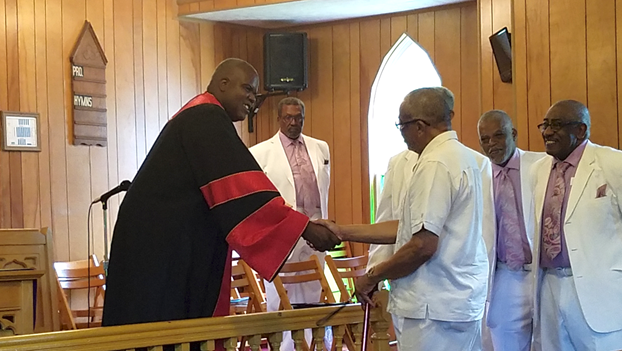
Reverend Billy Hunter meets with members of his congregation.
As a Presiding Elder, Hunter oversees 31 African Methodist Episcopal churches in Hampton Roads, Central, Western and Southwestern Virginia and reminds fellow leaders that faith and spirituality have a place in conversations about health.
“Just the very foundations of being a Christian–God tells us the body is our temple, and we are to protect the temple,” Hunter explained. “And what we do to protect the temple is what I call different types of prechecks. Such as, pre-exams, physicals, to let us know if there’s something not operating in the right parameter so that we can be proactive in correcting ahead of time.”
The “Man Up” Mentality
As Senior Pastor of New Beech Grove Baptist Church, Willard often finds himself addressing the mindset that men must “man up” and push through, even at the expense of their health.
“A lot of men are giving on empty,” Maxwell reflected. “We just run ourselves in the ground, pretty much…You’re taught to push your pain down, and it goes over into your health.”
It was a mindset that he also fell into, until he suffered a health scare in early 2025, which caused his perspective to shift and forced him to reconsider what strength really means.
“Sometimes our ego messes us up, we want to be the hero. We want to be Superman and then we realize we’re Clark Kent.”
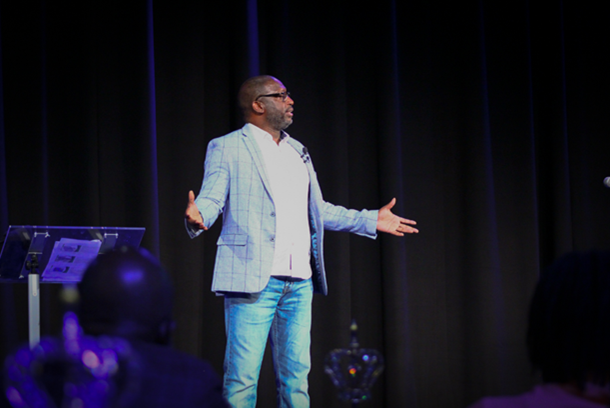
Pastor Maxwell uses his influence in the community to push forward the message of preventative health.
He has also witnessed men lose their lives over that mentality. He recalled a friend who was concerned for her fiancé, who was diagnosed with prostate cancer and refused treatment out of fear that it would affect his sexual function.
“She was talking to me, crying, ‘He said he would rather die than for them to cut or do whatever,’ and he ended up dying,” Maxwell said.
Now, health and wellness discussions have become a priority in Maxwell’s preachings. He recognizes that those who listen to him will be more willing to change their habits if they see him practicing what he preaches.
“It starts with us, and when they see us doing it, then they’ll begin to take care of themselves.”
The Bigger Picture – Health Disparities and Stigma
A prostate screening typically involves a prostate-specific antigen (PSA) blood test and, in some cases, a digital rectal exam. The DRE allows a doctor to feel for abnormalities on the prostate, which many men avoid because of stigma and discomfort.
Put simply, men are dying every day because they’re avoiding an awkward situation. Men fear losing their masculinity more than they fear losing their lives.
Advocating for early detection and prevention has long been an effort at the Hampton University Proton Cancer Institute and Sentara Health.
Every September, the two organizations, along with the Hampton Roads Prostate Health Forum, come together to host an early detection prostate cancer screening event, free and open to the public. This year’s 4th Annual Prostate Cancer & Men’s Health Awareness Fair is on Sept. 27.
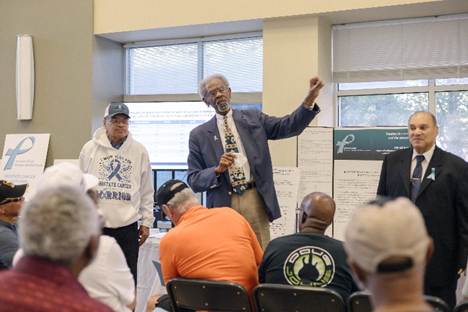
Hampton University Proton Cancer Institute, Sentara and the Hampton Roads Prostate Health Forum will host the 4th Annual Prostate Cancer & Men’s Health Awareness Fair on September 27.
Charlie Hill, prostate cancer survivor and co-founder of the Hampton Roads Prostate Health Forum, emphasizes the power of trusted spaces to spark conversation.
“After surviving prostate cancer, I realized how powerful it is when men hear the truth from someone who’s lived it,” Hill said. “When we bring these conversations into trusted spaces—like the church—we give men and their families a safe place to ask questions, talk about intimacy, and learn how to protect their health. Early detection saves lives, and I want every man to know that.”
Sentara’s team of cancer community educators in Hampton Roads works to ensure awareness and access to screenings are equitable.
“We’re going out to where people are. Meeting them at churches, health fairs, and not just once but consistently,” said Betsy Carroll, Sentara cancer community health educator. “Them constantly seeing us helps repair mistrust.”
Faith and Action Together
For 15 years, Hunter has emphasized health education in his ministry. Even during the coronavirus pandemic, he utilized virtual platforms, like Zoom, to host health-based conversations, highlighting that “leadership starts at the top.”
Similarly, Maxwell stressed that time on Earth is limited, and if men want to be active in their families’ lives, they must prioritize their own health. Many grow up believing they must always provide and never burden others, but, as he reminds them, “faith without work is dead” and “sometimes, you need to be selfish” when it comes to caring for themselves.
Both leaders urge men to end the stigma around talking about prostate cancer, starting these conversations among those who are bonded through faith. Their shared message is clear: prayer alone isn’t enough; men must also take action. “You need to pray, and go to the doctor,” Maxwell stressed.
Prostate cancer does not have to be a death sentence–it is a highly survivable diagnosis. With knowledge and early detection, men can take control and protect their health. Men over 40, especially those considered to be high risk or have a family history of prostate cancer, must talk to their doctors about a PSA test and a DRE. Individuals should also encourage their brothers, fathers, sons, and friends to do the same. The sooner men act, the better their chances of living a long, healthy life.
By combining faith, open dialogue, and encouraging proactivity, these leaders aim to help the men of Hampton Roads live healthier, longer lives.